



Acquisition of phonology and polyphony
Research Topics
Very much like in case the with both stuttering and dyslexia, I proposed that there might be a positive correlation between the presence of traditions of vocal polyphony and the later acquisition of phonology by children. This idea was the third offshoot of my idea of asynchronous shift to the speech of different human populations. You can see here relevant excerpts from my 2006 and 2011 books:
“My child said today ‘biscu-it’: Cross-Cultural Aspect of the Acquisition of Phonological System” from the 2006 book Who Asked the First Question?.
[...] We all are excited when our children start pronouncing their first words, maybe not so confidently in the start. Correct pronunciation is something that comes a bit later. Learning correct pronunciation, or, scholarly speaking, the acquisition of a phonological system, follows universal rules among the children of totally different ethnic and racial origins (Jakobson et al., 1963). At the same time, the idea that ancestors of different human populations shifted to articulated speech in different epochs, and that the prevalence of speech pathologies varies greatly as a result of this historical difference, leads to the proposition that the acquisition of the phonological system in the ontogeny of children from different regions may occur at different ages. In other words, according to the non-synchronous model of speech origins, children in East Asian, American Indian and Australian Aboriginal populations might acquire a phonologic system earlier than children of European or sub-Saharan African descent. To check this proposal one needs to compare the acquisition of a phonologic system among different populations on different continents. Fortunately, there are some studies and publications, which contain interesting information [... Continue reading]
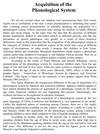
[...] According to the works of Paula Menyuk and Satoshi Nakajima, correct pronunciation of the phonologic system by American children starts from the age range of two and half to five years, while the same system is acquired by Japanese children from the age of one to three years (Menyuk, 1968). (Have a look at the graphic figure, ‘Acquisition of Phonologic System by Japanese and American Children’. This figure is based on the materials of two graphic figures from Paola Menyuk 1968 article.)
This figure illustrates the conspicuous difference in the age of acquisition of a phonological system by Japanese and American children. Japanese children appear to have almost finished the process of acquisition of a phonologic system by the same age when American children are just beginning this process. Interestingly, this evidence has been so far neglected in scholarly literature [... Continue reading]