



Tigers and Big Cats
Other Interests
My interest towards big cats (and particularly tigers) manifested itself from my early childhood years, and has stayed with me all my life.
During my school years, I was ardently collecting books and photos of tigers and other big cats, was  visiting zoo daily for years, and wanted to become a zoologist, geneticist, geographer, or a biologist.
 visiting zoo daily for years, and wanted to become a zoologist, geneticist, geographer, or a biologist.
 When my research of the origins of the choral singing brought me eventually to the human-big cat relationship, I enthusiastically embraced this line or research.
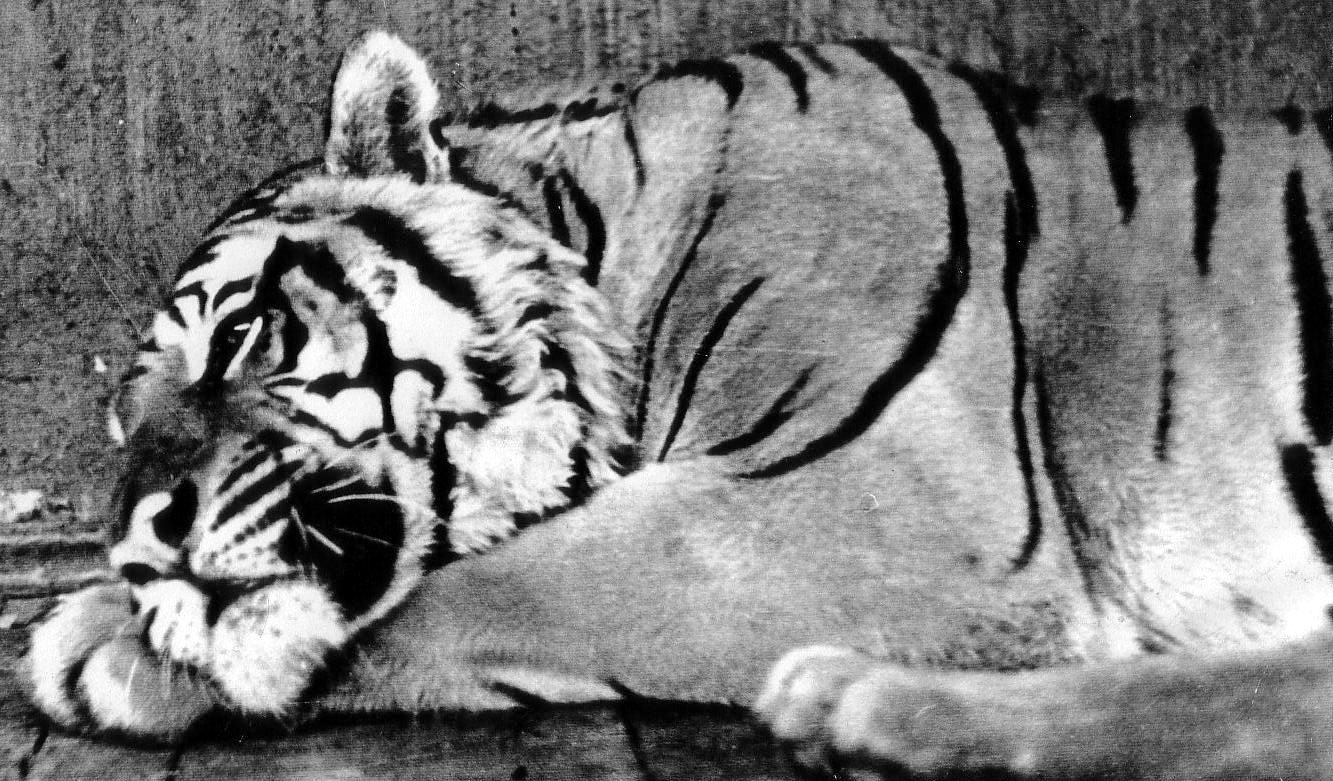
My interactions with the Siberian tiger “Mars” at Tbilisi zoo in the mid 1970s were particularly influential for me. That’s why the book on the human-big cat relationship is dedicated to the memory of Mars.
- You can read the complete book Tigers, Lions and Humans: History of Rivalry, Conflict, Reverence and love.
 [...] there must have been some kind of historical (or even evolutionary) bond between humans and lions.
 The nature and the history of this bond is the central topic of the research of this book.
Despite this long list of parallels in their evolutionary history, behaviour and morphology, lions and humans achieved their regal rankings via totally different strategies. Lions (and other big cats) deserve the title “king” through a lethal mixture of strength, grace, beauty, and the awesome power of their teeth and claws. In short, they are perfect predators, professional killers, a true masterpiece of evolution.
Humans, on the other hand, are slow, awkward-moving, naked primates virtually without teeth and claws, and if they were left with the limited abilities of their naked bodies, they would struggle to kill even a relatively small animal. Despite these shortcomings, humans managed to reach their ruling position among animals with the help of their unprecedented mental abilities, enabling them to transform and use materials from their environment in creative and truly unique ways. There is no doubt that humans are also a true masterpiece of evolution [... Continue reading]

- Also here you can read my unpublished memoir "The story of Mars, the Siberian Tiger" about my unusual six-year-long (1974 – 1980) friendship with a Siberian tiger at Tbilisi Zoo.
[...] On Tuesday, November 5th, 1974, Mars, a huge and beautiful Siberian tiger, the pride of Tbilisi zoo, refused to eat his food for the first time in his life. Zoo personnel took a serious note of this and observed his behaviour as Mars always had a great appetite. Mars refused to eat on Wednesday and then on Thursday, so his careers became more concerned. They gave Mars minced meat to make the eating process easier for him, but Mars neglected the minced meat as he had the earlier offerings. The worst part of Mars’ behaviour was that he was almost all the time lying in the corner of his cage with closed eyes.
On Friday the zoo personnel had a serious discussion on what might be the reason for the strange behaviour of an otherwise healthy Siberian tiger in the prime of his life. One of the zoo staff members suggested that a zoo visitor who was banned from the zoo just a few days ago could have poisoned the tiger in revenge, but another staff member did not agree with this suggestion. No one could actually explain what was wrong with Mars.
On Saturday and Sunday Mars was still lying in the corner of his cage with closed eyes, without paying any attention to the provided food. The tiger seemed as though he had lost interest in life.
It was clear that Mars was dying [... Continue reading]