



Books
Publications
INDEX
- Essays on Evolution of Music, Future of Education, Human Morphology and Behavior.
- Charles Darwin and Jim Corbett: Parallel Biografies.
- Choral Singing in Human Culture and Evolution.
- Behind the Jim Corbett’s Stories. Vol 1. Analytical Journey Through’ Corbett’s places’ and Unanswered Questions.
- Behind the Jim Corbett’s Stories. Vol 2.
- Why Do People Sing? Music in Human Evolution.
- Defense Strategies in Early Human Evolution.
- The Human Story Behind Scientific Discovery.
- Tigers, Lions and Humans: History of Rivalry, Conflict, Reverence and Love.
- A New Model of Human Evolution: How Predators Shaped Human Morphology and Behaviour.
- Who Asked the First Question? Origins of Human Choral Singing, Intelligence, Language and Speech.
- Origins and Development of Georgian Drone Polyphony.
- Georgian Traditional Polyphony in an International Context of Polyphonic Culture.
2024 (Eliva Press)
This book brings together several of Jordania’s important works published as journal articles or book chapters during the last two decades.
These cover a wide range of subjects, from the problems of Georgian traditional polyphony, issues of national minorities, origins of music and the phenomenon of polyphony, evolution of human morphology and behavior, the evolution of peacock’s dazzling train, the mysterious correlation between vocal polyphony and stuttering over the cultures, the future of children's education, and other topics.
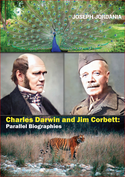
2023, edited by Preetum Gheerawo (Logos)
Isn’t it amazing how little we change from our childhood? During all my life, from my teenage years, I had two great role models, indicated in the title of this book, and that has not changed! But frankly, one thing has changed – I never thought I would ever be writing their biographies.
Although I have written a few books, I was always sure that I was not the kind of person who would write someone’s biography. To be a biographer is a totally different style of activity. So, I am starting this book a little bit unaware of where it takes me.
To avoid any misunderstanding, let me reveal from the very beginning that this book is not written as a ‘classic biography’. There are already a number of biographies about both Charles Darwin and Jim Corbett. This book is more of an attempt to display the psychological profiles of Darwin and Corbett, both seen from the very personal point of view of their lifelong admirer. A bit like their enhanced and colorised photos on the book cover (coloured photography was not available during their lifetimes), this book is the result of my deeply personal view on these two remarkable humans and self-taught naturalists.
Therefore, the text that follows this introduction will concentrate on their private lives and various major or minor circumstances (sometimes completely neglected in their more academically written biographies) that shaped them into the kindest and humblest human beings, great naturalists, and intensely adventurous and creatively thinking scholars.

2015 (Lambert Academic Publishers).
This is the second revised edition of the 2006 book
" I totally agree with the main idea of Joseph Jordania about the ancient origins of choral singing and its gradual disappearance. To my opinion also,there is no "evolution" from monophonic to polyphonic singing, and I was glad to see that the argumentation of this idea is so strong and logic". Simha Arom, CNRS, France.
"Joseph Jordania's book is a masterpiece of comparative musicology by a person with an amazing knowledge base. As a co-editor of the book "The Origins of Music"(2000), I am thrilled to finally see a true work of comparative musicology appear after many decades of neglect. This is the kind of material that people, from psychology to evolutionary biology, need to ponder as to incorporate music into the emerging picture of human evolution". Steven Brown, Simon Fraser University, Canada.

2020 (Logos)
P. Gadhvi, P. Gheerawo, M. Waltl, A. Akhtar, J. Jordania, F. Quevedo de Oliveira
The authors of this volume, all members of the Jim Corbett International Research Group, continued their fieldworks in Kumaon, where they diligently followed the footsteps of Jim Corbett, meeting the people directly affected by Jim Corbett’s life and work - people who still live in picturesque villages in close proximity to tigers and leopards. The authors have also searched through and dissected archived material, unearthing new facts to share with the many Corbett fans all around the world.

2016 (Logos).
In his life time, the India domiciled Jim Corbett, a man of Irish ancestry, lived as did many a colonial in British India, working hard to make a simple living and, through the monsoon months of every year, enduring the tropic heat of the Indian sun, the flies, the mosquitoes, the inevitable fevers and dysentery, and the inscrutable minds of the colony’s enigmatic, indigenous people. In regard to the latter, he had one great advantage and that was, being born in India, he was thoroughly fluent in the language and customs of the great subcontinent and understanding of the simplicity and superstition that was with them a way of life ...

2011 (Logos)
The book proposes that music originated as a tool for audio-visual intimidating displays against predators and competing groups. I argue that synchronous group singing creates a "battle trance", transforming individuals into a unified, fearless, and pain-ignoring group ready for conflict. This "battle trance" was a primary evolutionary function, and the book also explores music's links to cognitive processes like language and its role in fostering collective identity, trust, and commitment for group survival.
The book was written after a publisher from ERC (Tokyo) commissioned me to write a shorter version of my 2006 book for a more popular reader.
This book includes many new ideas not present in my 2006 book. The book came out in English in 2011 (Logos), and was later also translated into Chinese (2014), Japanese (2016), and Georgian (2016).
2024 (Logos)
How did our distant ancestors defend themselves from lethal African predators after they moved from the trees to the ground and started sleeping in the open? Strangely, this important question of human evolutionary history has been largely ignored by scholars ...
On June 23-26, 2023, an international muti-disciplinary conference “Defense Strategies in Early Human Evolution” took place at the Jim Corbett International Research Centre at the Grigol Robakidze University, Tbilisi, Georgia. The conference brought together behavioural ecologists, primatologists, biologists, cognitivists, philosophers, evolutionary musicologists, and conservationists, who were discussing various issues of this vast topic. The book that you hold in your hands is the result of this meeting.. Jordania, Joseph. (2024). Defense Strategies in Early Human Evolution.

2020 (Logos)
How is the existing system of education shaping future scholars? How do the politics of grants and funding science affect scholarly development? Why were some of the brightest figures of scientific progress not academically educated? How do universities influence scientific progress? How does the peer-review process advance or depress scientific discovery? Jordania tackles the thorny issues of scholarly integrity, reputation, and corruption. These topics fundamentally affect the everyday lives of thousands of scholars, both professional and non-professional, and have a profound influence on the advancement of science.
“The Human Story Behind Scientific Discovery will be seen as one of the most important books of our time. It’s far-reaching, fascinating, and flawlessly truthful, with a message so unexpected that most readers will experience a tsunami of realization mixed with shock. It will change some of us and redirect others, and once you’ve read it, it will stay with you for life. Its truths cannot be ignored and are impossible to forget.” Elizabeth Marshall Thomas, author, The Hidden Life of Dogs and The Hidden Life of Life.
“When was the last time you read a book that has a fresh idea or insight on almost every page? Joseph Jordania’s questioning and creative mind is well suited to describing the contributions made by passionate developers of new knowledge who in their time were considered outsiders, or mavericks, if they were considered at all. Jordania’s own unorthodox observations will move the reader to think ‹Hmm, That makes sense!›” Ellen Dissanayake, Author, What Is Art For? and Homo Aestheticus.
“A dazzling, inspirational tour de force. Joseph Jordania exceeds his goal of presenting the human dynamics of scientific discovery sketched by Popper, Kuhn, and Feyerabend. Not content to identify the malignant, pervasive barriers to the advancement of science, he provides an insightful, comprehensive guide to overcoming institutionalized resistance that will put heart into aspiring scholars, scientists, and seekers and challenge the gatekeepers and systems that hold back innovation.” Jenny Wade, author, Changes of Mind: A Holonomic Theory of the Evolution of Consciousness and Transcendent Sex: When Lovemaking Opens the Veil.

2017 (Lambert Academic Publishers)
The central theme of this book is the new model of human evolution, based on long and dynamic evolutionary interaction between human ancestors and the ancestors of the big cats.
“The most revolutionary evolutionary theory in decades!”. Wladimir J. Alonso (Brazil), Evolutionary biologist.
“Truly original work! A reader will be surprised by many of his findings, all of which make perfect sense, and one will wonder why they weren’t mentioned before. The reason certainly seems to be that Jordania saw them first”. Elizabeth Marshall Thomas (USA), author of the "The Tribe of Tiger and The Hidden Life of Dogs".

2014 (Logos)
The book argues that evolutionary competition between humans and big cats was a key factor in human evolution.
Text explores the long-standing relationship between humans and big cats, covering the historical conflict, how it shaped human morphology and culture, and the eventual shift to reverence, love, and even symbolic meaning...

2006 (Logos)
The book explores the origins of human choral singing, intelligence, and language, placing it within a wide interdisciplinary context. The central theme is that traditional choral singing's ancient origins are linked to the evolution of human intelligence, speech, and other related issues.
Was written already in Australia in 2006. In 2009 the book received Fumio Koizumi award in ethno-musicology: “In recognition of his contribution to systematic analysis of folk polyphonies of the world, proposing a new model for the origins of traditional choral singing in a broad context of human evolution.”
Origins and Development of Georgian Drone Polyphony
My first book, written in Georgian in 1984, was never published, although for some time it was on the plan of state publishing house Khelovneba.
Georgian Traditional Polyphony in an International Context of Polyphonic Culture (To the Problems of Origins of Polyphony).
1989 (TSU Press)
My next book was written in Russian and was published by the Tbilisi State University Press.