



Sexual selection or Natural selection?
Research Topics
During my research I came to the conclusion that the importance of sexual selection in evolutionary literature is grossly overrated. In many cases, I believe we need to instead be talking about the aposematic strategy of survival from predators and avoiding lethal aggression from conflicting animals with the same warning display.
The mechanisms of aposematic display and the mechanisms of sexual selection are virtually identical, as both are based on the use of body size, use of colours and strange morphological additions to the body, audio signals, the use of smells, and display of fearless and sometimes strange behaviours. Mainstream contemporary evolutionary scholarship is heavily inclined towards explaining any such elements of morphology and behaviour via the mechanisms of sexual selection.
Even the term “aposematism” is not known to many biologists. In my writings I try to bring the power and relevance of aposematic display to the attention of evolutionary scholars and ecological behaviourists. You can read further here:
- "Aposematic Model vs. Sexual Selection Model of Human Evolution": excerpt from the book Why Do People Sing?.
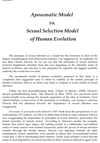 [...] The principle of sexual selection as a model for the evolution of most of the
human morphological and behavioural features was suggested by an authority no
less than Charles Darwin. So we can say that the principles of sexual selection
received heightened attention from the very beginning of the scholarly study of
human evolution, also because it was proposed by arguably the biggest scientific
authority the world has ever seen.
The aposematic model of human evolution, proposed in this book, is a
completely new suggestion and, to check its viability as the central principle of
human evolution, there is no better way than to compare it to the model of sexual
selection [... Continue reading]
[...] The principle of sexual selection as a model for the evolution of most of the
human morphological and behavioural features was suggested by an authority no
less than Charles Darwin. So we can say that the principles of sexual selection
received heightened attention from the very beginning of the scholarly study of
human evolution, also because it was proposed by arguably the biggest scientific
authority the world has ever seen.
The aposematic model of human evolution, proposed in this book, is a
completely new suggestion and, to check its viability as the central principle of
human evolution, there is no better way than to compare it to the model of sexual
selection [... Continue reading]- "Short History of the idea of Aposematism": excerpt from the book Tigers, Lions and Humans.
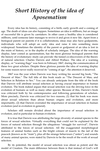 [...] Every idea has its history, consisting of a birth, early growth and a coming of age. The death of ideas can also happen. Sometimes an idea is stillborn, but an image of successful life is given by caretakers. In other cases a healthy idea is considered stillborn, until someone later manages to revive it and gives it new life. Apart from a biological parent (or parents if it is collaboration), ideas may also have godparents, individuals who will adopt an early idea and raise it into something more widespread. Sometimes the identity of the parent or godparent of an idea is lost in the mists of history, or in the depths of scholarly intrigue. The idea of the warning display, later coined as aposematism, has the most glorious biological parents that the history of evolutionary study can provide: the famed co-discoverers of the theory of natural selection: Charles Darwin and Alfred Wallace. The idea of a warning display, or “warning flags” was born in February 1867, during the communication of these two great scholars. Despite these glorious parents the idea of warning display for some reason never really received its “coming of age”, the attention it deserved [... Continue reading]
- “Sexual Selection or Natural Selection? New Look on the Evolution of Human Morphology, Behavior and Art”. A special journal article in Kadmos, Volume 3, 2011: 400-416
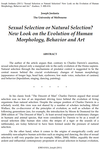
Abstract: The author of the article argues that, contrary to Charles Darwin’s assertion, sexual selection played only a marginal role in the early evolution of the Homo sapiens. Natural selection through the mechanisms of predator control is suggested to be the central reason behind the crucial evolutionary changes of human morphology (appearance of longer legs, head hair, eyebrows, low male voice, reduction of canines) and behavior (bipedalism, singing, dancing, painting) [... Continue reading]